


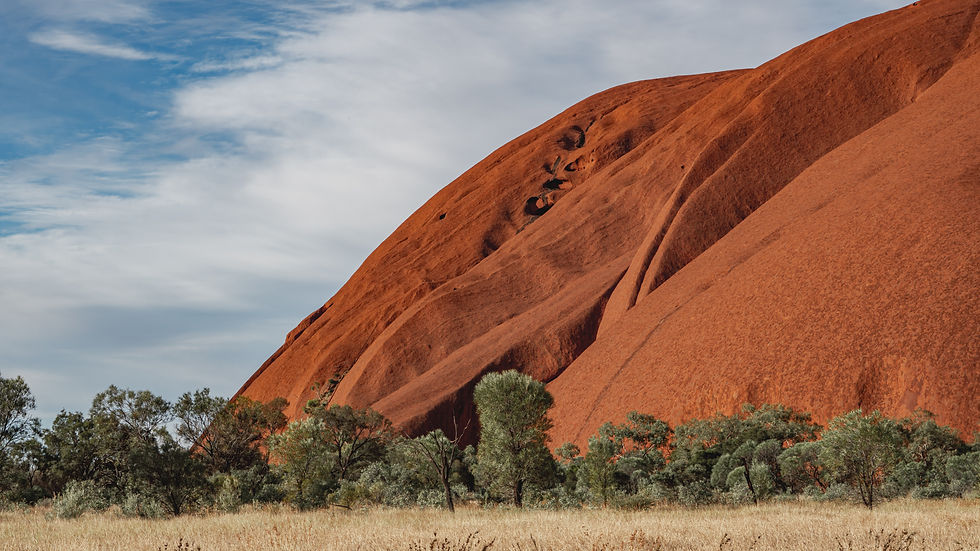
ULURU
The Spiritual Heart of Australia
Uluru was formerly known as 'Ayres Rock' though it is no longer appropriate to refer to it as such.
PLEASE USE THE TRADITIONAL NAME, 'ULURU' (OO-LOO-ROO)
Uluru is one of the most popular and iconic tourist destinations in Australia. Its striking red colour, unique geological features and rich Cultural significance draws millions of world-wide visitors every year.
Uluru is home to many Sacred sites. These special places are deeply significant to Anangu. First things first, listen and learn about Tjukurpa and be fascinated by Anangu stories that go back over 40,000 years!
START FROM THE
BEGINNING
BEFORE YOU VISIT ULURU...
Anangu
The main focus of your visit to Uluru should be to learn about one of the oldest surviving Cultures on planet Earth. Respect is paramount. Do your research and learn about the Traditional Custodians of Uluru and their way of life.
FREE
DOWNLOAD!
Sacred Sites
Uluru is home to many Sacred sites for the Anangu so please respect their Cultural heritage by following designated paths, avoiding restricted areas and refraining from photography in specific locations, as per their request. No photography zones are clearly signed.
As non-Indigenous people to the area, it is a privilege that we are able to visit such a significant Cultural place, so please do the right thing.

T-shirt from 'Clothing the Gaps'
Climbing Uluru
Historically, climbing Uluru was a popular activity for many visitors. Accidents occurred regularly. Many injuries and deaths were recorded. Climbing Uluru is NOT a part of Anangu Culture. Uluru holds deep spiritual significance for Anangu and was used for ritualistic and ceremonial purposes tied to Tjukurpa (Anangu law and spirituality). The climb at Uluru officially closed on October 26th, 2019. Respectfully, please do not climb Uluru.
The Scar
The construction of a chain was commissioned in the 1960's by a local cattle station owner. The chain gave the false impression that climbing Uluru was safe and promoted the climb to uneducated tourists and unsuspecting adventure seekers. The chain was removed once the climb officially closed. To this day you can still see a visible scar of erosion on Uluru, next to where the chain was located. In a local Indigenous language, the scar is referred to as 'Tjapanangka'. It represents a wound; symbolic of the land's vulnerability, reminding Anangu and visitors of the consequences of disrespecting the land and cultural practises.
Sorry Rocks
Removing rocks, sand or natural elements from the landscape is disrespectful to Traditional beliefs and Culture. Many visitors remove rocks and pebbles from Uluru as souvenirs to take home. Do NOT do this under any circumstances. Removing rocks, soil and sand from the park is illegal and against Anangu protocols. Take Uluru home in your heart, not in your pocket!
Despite this, some visitors still chose to take natural souvenirs from Uluru, only to return it days, weeks or months later due to bad energy that most may commonly refer to as 'karma'. Between 2002 and 2005 alone, over 800 packages of returned rocks, pebbles and sand (accompanied by hundreds of letters of apologies) were received. These 'Sorry Rocks' were used to fill in the holes in Uluru that the chain left behind. Returned to their rightful home, at last.
Park Rangers still receive countless Sorry Rocks in the post today. Don't become another statistic.


VISITING ULURU
The Cultural Centre
Uluru & Kata Tjuta Cultural Centre was designed to provide visitors insight to the Cultural and spiritual significance of Uluru and the surrounding areas. It was opened in October 1995 to coincide with celebrations marking the 10th anniversary of the land hand-back to Aboriginal Traditional Custodians.
Interpretive displays at the Culture Centre convey Cultural messages about Anangu Culture and how to interpret their way of life. The building itself is an art-piece; resembling two snakes from the Anangu Creation time; Kuniya & Liru.
Self-education, research into Anangu Culture and a visit to the Cultural Centre is the best place to start your Uluru experience. When visiting, enter through the Tjukurpa tunnel and enjoy the self-guided experience.
-
No photography or filming is allowed inside the Cultural Centre.
-
Do not handle any display items.
-
Keep your voice and noises to a minimum, allowing others to engage in a peaceful experience.
-
To respect Anangu law, the photos of deceased people on display have been covered.
The Cultural Centre has an abundance of visitor information, free maps and resources, a cafe, a gallery and shops.
Walking Tracks
Throughout Uluru Kata Tjuta National Park, walking tracks have been established to provide visitors with a safe, comfortable and enjoyable experiences whilst protecting the surrounding landscape and Sacred sites. With rainfall less than 300mm per year, the impact that visitors can have on the natural environment is severe and the importance of staying on marked tracks cannot be overstated.
Signs and associated publications encourage people to learn about the natural and Cultural significance of Uluru. Whilst it is recommended to visit with a knowledgeable Tour Guide or with Anangu, these signs allow you to visit Uluru on your own accord and learn at your own pace.
There are several tracks around Uluru to offer a variety of natural experiences. From short walking tracks designed for wheelchair access to more demanding requirements for Valley of the Winds and Uluru Base Walk, there are tracks to suit everyone.
Viewing Areas
Throughout Uluru Kata Tjuta National Park there are viewing platforms to make the most of your experience (and your photography). Find the most appropriate viewing area for you and make sure you check the opening and closing times of these areas. These sunset / sunrise viewing areas spots require a vehicle to get to.
It's important to stick to designated tracks at Uluru for Cultural, Environmental, Safety and Sustainability reasons.
There are many Sacred sites at Uluru. Sticking to paths and following the signs ensures that you do not disturb areas of spiritual or historical importance.
Please show your respect.
Many animals rely on undistrubed envirnments for survival. Going off-track can damage their habitat or disrupt breeding patterns.
Foot traffic damages fragile ecosytems and leads to soil erosion. Some vegetation may take decades to recover after trampling. Tread lightly, with purpose.
ULURU - KATA TJUTA
NATIONAL PARK
Uluru - Kata Tjuta National Park has received awards and recognition for its Cultural & natural significance.
UNESCO World Heritage Site
Inscribed in 1987 due to its outstanding universal value.
Tourism Awards
Various tourism awards for sustainable practises & providing exceptional visitor experiences.
Eco-Certifications
The park has been recognised for its commitment to sustainability & responsible tourism. Various eco-certifications & awards highlight efforts to preserve the delicate desert ecosystem.
National Park Management
The park is managed in partnership with Anangu representatives who are Traditional Custodians of the land; actively participating in decision making processes related to management of the park.

OWNERSHIP AND MANAGEMENT
Standing at 348 metres | 1142 feet tall, Uluru is located in the centre of Australia, in the Uluru & Kata Tjuta National Park which is situated in The Northern Territory. The National Park covers and area of 1325 square kilometres | 512 square miles. For comparison, that's twice the size of Singapore or roughly the same size as Los Angeles.
This land is 'owned' by Anangu, the Traditional Custodians of the land, who were granted free-hold title in 1985. The National Park is leased to Parks Australia (federal government) under a co-management agreement. This partnership ensures that Anangu Cultural Traditions and knowledge are integrated into the National Park's management, whilst also maintaining conservation and tourism operations.
" THE LAND DOES NOT BELONG TO US; WE BELONG TO THE LAND. "
Custodianship
There are HUGE differences between custodianship and modern land ownership. For Indigenous Australians, land is not something to be owned, bought or sold. It is a living, breathing entity that has cultural, spiritual and historic significance. Custodianship is about care, respect and stewardship rather than control or ownership. The land is not an asset to be exploited but a sacred and interconnected system that must be protected for future generations.
Land 'Ownership'
In Western framerworks, land ownership is viewed in terms of legal rights, property laws and economic value. The notion that land can be bought, sold and developed often ignores the deeper, spiritual relationship that Indigenous People(s) have with the land. This stark contrast in perspective has led to ongoing debates about land rights and reconciliation between Indigenous and non-Indeigenous Australians, all over the continent.
HAND-BACK
On October 26th of 1985, the Australian government officially returned 'ownership' of Uluru Kata Tjuta National Park to Anangu. This event marks a significant milestone in recognising Indigenous Land Rights and Cultural heritage in Australia.
The Beginning of Time
For 10s and thousands of years prior to European arrival in Australia, Uluru & Kata Tjuta was Aboriginal Land.
Early 20th Century
In the 1920's, non-Indigenous Australians afforded the Anangu a limited area to live as the reserve was partitioned for tourism and wildlife use.
Mid 20th Century
1963 - Yolngu Bark Petition
1965 - The Freedom Bus Ride
1966 - Gurindji Wave Hill Walk-Off
1967 - National Referendum
1973 - Development of the Land Rights Act
October 26th, 1985
The land was officially handed back. Hand-back came with conditions. One condition includes that Anangu are to lease their lands to National Parks for a minimum of 99 years. The lease also obliged the Director to promote Aboriginal administration, management and control of the National Park.
Name Change
The name of the park was officially changed back to 'Uluru - Kata Tjuta National Park in 1993.
Working Together
Anangu were unable to care for their land the way their Ancestors had taught them to for a considerable amount of time and still face many obstacles. Sacred places were not looked after properly. The land wasn't managed, therefore could not regenerate. Since the land hand-back, Anangu and Australian government board members have worked together in a process recognised as 'joint management'.
Picasso Gold Medal
In 1995, the National Park was given the highest honour in World Heritage; the Picasso Gold Medal. The award recognised the outstanding efforts of the parks Board of Management (Indigenous + Non-Indigenous decision makers).
20th Anniversary
In 2005, Anangu and Pirampa (white people) celebrated 20 years since the return of the land to its Traditional People.
Present Time
39 years of the 99 year lease has passed. The joint management of Uluru Kata Tjuta National Park between Anangu and Parks Australia is recognised as a successful model for collaborative conservation and Cultural preservation. The approach of involving Indigenous People(s) in the management of culturally significant sites, such as Uluru, is praised internationally for its respect towards Indigenous Rights and environmental stewardship. It serves as an example of how cooperation can lead to sustainable management of natural and cultural heritage.

THE BEGINNING OF TIME...
Anangu believe that in the beginning, the Earth was flat, dark and featureless. Life on Earth began when totemic Ancestors (supernatural beings) of plants, animals and people woke from their slumber and walked across Country, creating a trail of 'life'. All features of our environment are believed to have been shaped by these Ancestors, including the rocks, cliffs, mountains, trees, rivers and waterfalls etc. Once the totemic Ancestors completed Creation they returned to the Earth.
Stories of Totemic Beings and Ancestors are respectfully referred to as Creation Stories, but are more commonly known as Dreamtime Stories. Some Indigenous Australians (particularly Anangu) find the terms 'dreaming' or 'dreamtime' an offensive slur, implying that their beliefs are made up (like a dream).
The landscape that the first Aboriginal People here saw (40,000+ years ago) looked much the same as it does today. Science suggests that the sand dunes have remained in their current position for an 225,000 years!
ULURU GEOLOGICAL EXPLAINATION
There were 3 main geological stages in the creation of Uluru:
Sedimentation | 550 million years ago
Uluru was once part of an ancient sea-bed. Where Uluru is situated today was once entirely underwater! Sand and rock sediments accumulated in this shallow in-land sea. Over time, the sand and rock compacted into 2 different types of rock. Sandstone (which formed Uluru) and Conglomerate Rock (which formed another ancient rock formation, Kata Tjuta).
Uplift & Folding | about 350 million years ago
Tectonic forces (from the collision of continents) folded and uplifted Earth's rock layers. Uluru, originally lay flat but was then uplifted and tilted almost 90 degrees into the air. If you look at Uluru today from afar, you will see vertical striation marks, indicating the sedimentary layers.
Erosion & Exposure | the past 300 million years
Uluru's surrounding landscape eroded away. The iron content in the sandstone oxidised (rusted) giving Uluru its natural iconic red colouring. The rock itself is actually grey/blue! What we see of Uluru today is only the very tip of the rock formation, which extends several kilometres underground. Some geologists theorise that Uluru and Kata Tjuta are connected, underground!
MONOLITH OR INSELBERG?
Uluru is BOTH.a monolith and an inselberg. but it is more accurately described as an inselberg.

Monolith (Single Rock Formation)
A monolith is a single MASSIVE rock or stone that stands alone. Uluru fits this definition because it is composed of a single type of rock: arkose sandstone.
Inselberg (Isolated Eroded Rock)
An inselberg is a german term for 'island mountain'. It is a rock formation that rises abruptly from a flat landscape due to erosion. Uluru is an exposed part of a much larger underground rock formation and the surrounding land has eroded away over millions of years.
While Uluru is commonly referred to as a monolith, geologists consider it an inselberg because it was once buried and later exposed by erosion.


